How to Define Curls Without Gel: 7 Easy Ways to Get Soft, Defined Curls
Published: 16 Jul 2026
How to define curls without gel is one of the most common questions people with naturally curly hair ask. Curls often look smooth and defined when wet, then turn frizzy, flat, or separated as they dry. I know how frustrating that feels, but you are not alone, and it does not mean your hair is unhealthy or impossible to manage.
Many people believe hair gel is the only way to get defined curls, but that’s a common misconception. While traditional hair gel can provide strong hold, some formulas feel crunchy, sticky, dry, or heavy. Using too much or layering products that don’t work well together can also lead to flakes and product buildup.
The good news is that you can achieve soft, defined curls without relying on traditional hair gel. This guide will show you a simple step-by-step routine, the best alternatives to hair gel, curl-defining techniques, and tips for every curl type so you can enjoy healthy, touchable curls that last longer.
Can You Define Curls Without Gel?
Yes. You can achieve curl definition without traditional hair gel by focusing on healthy hair moisture, the right styling techniques, and careful drying. Water and conditioner help strands gather into natural curl clumps, while gentle styling keeps those clumps together until your hair dries.
You have two main options:
- Gel-free styling: Use lightweight products like mousse, curl cream, leave-in conditioner, or a styling lotion for soft definition and flexible hold.
- Product-free styling: Rely on water, proper conditioning, scrunching, and gentle drying without using a leave-in styling product.
Product-free natural curls often feel softer and more touchable, but they usually have less hold. Humidity, wind, exercise, and even sleeping can separate curl clumps more quickly. If you want longer-lasting definition without a crunchy finish, a lightweight mousse is often one of the best alternatives to hair gel.
Why Do Curls Lose Definition?
Water makes curls more flexible and encourages strands to clump together. As your hair dries, movement and friction can separate those clumps, leading to frizz and uneven curl definition. Humidity can also affect the hair fiber, especially if your hair has been exposed to heat styling, chemical treatments, or everyday wear.
The hair cuticle is the outer protective layer of each strand. When it becomes rough or damaged, friction increases, making curls more likely to tangle, separate, and become frizzy. While conditioner cannot repair damaged hair permanently, it coats the hair surface, reduces friction, improves moisture retention, and makes curls easier to manage.
Other factors can also reduce curl definition, including product buildup, rough towels, brushing dry curls, high diffuser airflow, damaged ends, heavy styling products, and touching your curls before they are completely dry. Hair porosity is only one piece of the puzzle. Your hair density, strand thickness, overall hair health, and local climate also play a major role in how well your curls hold their shape.
How to Define Curls Without Gel: A 7-Step Routine
Learning how to define curls without gel starts with a simple routine that supports moisture, curl clumping, and gentle styling. Follow these seven steps to create soft, defined curls that last longer without the crunchy feel of traditional hair gel.
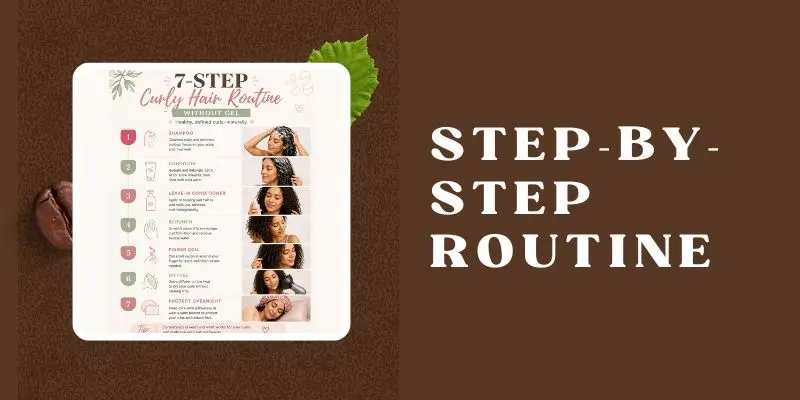
Defined curls that last longer without the crunchy feel of traditional gel.
1. Cleanse Away Dirt and Product Buildup
Start by washing your scalp with a gentle shampoo that removes dirt, oil, and leftover styling products without stripping away too much moisture. If your curls feel coated, limp, sticky, or difficult to wet, it may be time to clarify.
There is no single schedule for clarifying because every curly hair routine is different. People who regularly use heavy creams, oils, or butters may need to clarify more often than someone who only uses a lightweight mousse. Co-washing works well for many people, but over time it can leave some hair feeling weighed down.
The American Academy of Dermatology (AAD) recommends considering a clarifying shampoo if you regularly use styling products such as gels, creams, oils, or pomades.
2. Condition and Restore Moisture
Apply conditioner from the mid-lengths to the ends, paying extra attention to dry or damaged areas. Detangle gently in sections using your fingers or a wide-tooth comb, starting at the ends and working upward to reduce breakage.
If your curls still feel dry after conditioning, add deep conditioning treatments to your routine once a week to improve softness, moisture retention, and overall curl definition. Fine or low-porosity hair usually benefits from lightweight moisturizing products and a thorough rinse, while coarse, thick, or weathered hair often needs a richer conditioner for lasting hydration.
3. Keep Your Hair Wet While Styling
Styling on wet hair helps strands form larger, smoother curl clumps. Soaking-wet styling often works best for curls and coils because water spreads products more evenly. People with wavy hair may notice more volume when styling on damp hair instead.
Try both techniques on different wash days to see which gives you the best results. If any section begins to dry while styling, lightly mist it with water before continuing.
4. Apply a Lightweight Curl-Friendly Product
Choose one lightweight styling product first so you can clearly see how it affects your curls.
- Mousse or foam: Flexible hold and added volume
- Curl cream: Soft definition with light control
- Leave-in conditioner: Moisture and slip with minimal hold
- Styling lotion: Flexible, medium support
- Natural oils: Add shine and help reduce moisture loss, but provide little to no hold.
Start with a small amount, especially if you have fine, wavy, or low-porosity hair. Applying too many curly hair products can reduce volume, increase buildup, and make curls lose their natural bounce.
5. Choose a Curl-Defining Technique
The best curl-enhancing techniques depend on your curl pattern, hair density, and the finish you want. Experiment with different styling techniques until you find the one that gives you the most consistent curl definition.
Scrunching
Best for: Type 2 waves and Type 3 curls
Cup the ends of your wet hair, lift them toward your scalp, gently squeeze, and release. Avoid rubbing your strands together, as this can break up curl clumps and increase frizz. Scrunching is one of the easiest ways to define curls naturally while keeping them soft and bouncy.
Finger Coiling
Best for: Ringlets and uneven curl sections
Smooth one wet curl clump, wrap it around your finger, then gently release it. If styling your whole head feels too time-consuming, finger-coil only the sections that lose definition easily.
Finger Raking
Best for: Even product distribution through thick or dense hair
Glide your fingers through wet hair to spread your styling product evenly, then scrunch to encourage curl clumps. If your curls begin looking thin or stringy, reduce the amount of raking and rely more on scrunching.
Shingling
Best for: Type 3 curls and Type 4 coils
Work with small sections and smooth the product from the roots to the ends of each natural curl clump. Shingling takes longer than other methods, but it often creates excellent curl definition and helps reduce frizz.
Brush Styling
Use a curl-defining brush on wet, fully detangled hair. Brush each section with gentle tension, then lightly shake or scrunch the hair to encourage natural curl ribbons. Never brush dry curls, as this can increase frizz and breakage. The American Academy of Dermatology (AAD) also recommends detangling wet hair and avoiding dry brushing to help protect curly hair.
6. Dry Your Curls Without Creating Frizz
Drying your curls the right way is just as important as the products and styling techniques you use. Gentle drying helps preserve curl clumps, reduce frizz, and improve long-lasting definition.
Start by micro-plopping with a microfiber towel or a soft cotton T-shirt. Gently press sections of your hair to remove excess water without disturbing the curl clumps. If you prefer regular plopping, wrap your curls loosely for a few minutes instead of twisting them tightly.
You can either air-dry or diffuse your curls. When diffusing, use low airflow and low to medium heat to help preserve curl definition and reduce frizz. Begin by hovering the diffuser around your hair, then gently cup sections once they start to dry. Avoid rough towels, high airflow, excessive heat, and touching damp curls, as these can separate curl clumps and increase frizz. The American Academy of Dermatology (AAD) also recommends wrapping wet hair instead of rubbing it and limiting excessive heat exposure to help reduce hair damage.
7. Protect and Maintain Curl Definition
Protecting your curls while you sleep can help them stay defined for longer.
Sleep with a satin bonnet or on a smooth satin or silk pillowcase to reduce friction. If you have medium to long hair, try the pineapple method by loosely gathering your dry curls near the top of your head without pulling them tightly. People with tighter coils may also benefit from loose twists or braids, as long as they do not create tension.
In the morning, lightly mist flattened sections with water or a diluted leave-in conditioner to refresh your curls. Avoid layering heavy products every day because buildup can reduce volume and make curls look dull.
6 Best Alternatives to Hair Gel for Curl Definition
If you want soft, defined curls without the stiff feeling of traditional hair gel, choose a product based on your hair type, desired hold, moisture needs, and climate.
| Alternative | Hold | Best For | Benefit | Limitation |
|---|---|---|---|---|
| Mousse or foam | Medium | Waves and fine curls | Lightweight volume and flexible hold | Less humidity control |
| Curl cream | Low–Medium | Dry Type 3 curls | Soft curl definition | May feel heavy on fine hair |
| Leave-in conditioner | Low | Dry, tangled hair | Moisture and slip | Minimal long-lasting hold |
| Aloe-based styler | Low–Medium | Lightweight styling | Hydration with a natural feel | Results vary by formula |
| Shea butter or styling butter | Low | Thick, dry coils | Rich moisture and softness | Too heavy for many waves |
| Flaxseed-based styler | Medium–Strong | Defined curl clumps | Flexible hold with natural ingredients | Still behaves like a gel |
Flaxseed-based stylers are a popular choice for people who want to avoid many traditional synthetic gels, although they still work like a styling gel. Homemade aloe vera or flaxseed recipes should always be made in small batches, stored properly, and discarded if the smell, texture, or appearance changes. Always perform a patch test before using any new product.
In general, mousse provides more flexible hold than a leave-in conditioner, while curl cream focuses on softness and moisture. Shea butter works best for thick, dry coils but can weigh down fine or wavy hair. Aloe-based products also work differently depending on your hair type and the product formula.
Choose your styling product based on your hair type and the finish you want. Mousse works well for lightweight hold and volume, while curl cream is a better choice if your hair needs extra moisture and softer definition.
How to Define Different Curl Types Without Gel
Every curl type responds differently to styling, so there is no one-size-fits-all routine. Your curl pattern, hair density, porosity, strand thickness, and even your local climate all affect how well your curls hold their shape and stay defined.
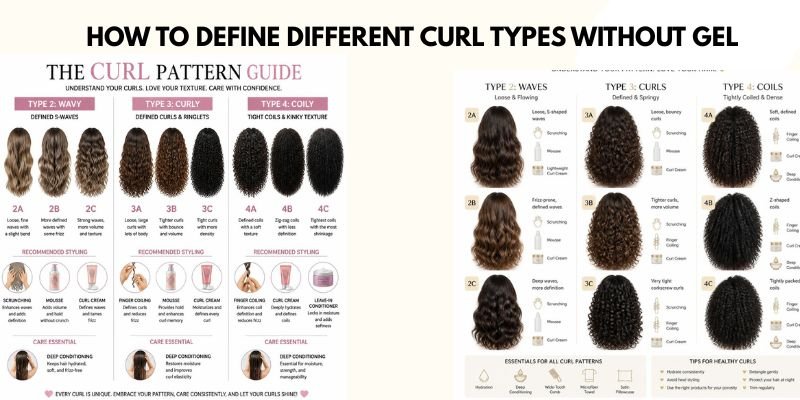
If you’re unsure where to begin, identify your natural curl type with our Hair Types Chart. To better understand how your hair absorbs and retains moisture, read our Porosity Hair Guide. Knowing both your curl type and hair porosity will help you choose the right products and styling techniques for better curl definition.
How to Define Type 2 Waves Without Gel
For Type 2A, 2B, and 2C waves, use a lightweight leave-in conditioner followed by a small amount of mousse for flexible hold. Scrunch upward, micro-plop with a microfiber towel, and diffuse on low heat if you want extra volume. Heavy creams, butters, and oils can easily weigh down wavy hair and reduce definition.
If you have loose waves, our Type 2A Hair Guide, Type 2B Hair Guide, and Type 2C Hair Guide explain the best routines and products for each wave pattern.
How to Define Type 3 Curls Without Gel
For Type 3A, 3B, and 3C curls, apply a lightweight curl cream or mousse to soaking-wet hair. Finger coil uneven sections, brush-style larger sections, or use the shingling method for extra control. Allow your curls to dry completely before separating them to reduce frizz and maintain curl definition.
For more personalized routines, explore our Type 3A Hair Guide and Type 3C Hair Guide.
How to Define Type 4 Coils Naturally
For Type 4A, 4B, and 4C coils, focus on moisture first. Apply a leave-in conditioner followed by a curl cream or butter if your hair needs extra hydration. Shingling and finger coiling help define your natural curl pattern, while twist-outs and braid-outs create a more stretched, uniform look.
Allow your hair to dry completely before separating the sections. Gentle banding can help stretch coils without heat, but avoid pulling too tightly. Protect your curls overnight with a satin bonnet or pillowcase to reduce friction and preserve definition.
If you need more product recommendations or styling tips, see our Type 4A Hair Guide, Type 4B Hair Guide, and Type 4C Hair Guide.
How to Get Defined Curls Without Styling Products
You can still improve curl definition without products, although the results may not last as long as a routine that includes a lightweight styler.
Follow these simple steps:
- Cleanse away dirt and product buildup.
- Condition and gently detangle your hair.
- Rinse while keeping natural curl clumps together.
- Style your hair while it is still wet.
- Scrunch gently to encourage curl formation.
- Micro-plop with a microfiber towel or cotton T-shirt.
- Air-dry or diffuse on low airflow.
- Avoid touching your curls until they are completely dry.
Without styling products, your curls rely more on your natural curl pattern, haircut, hair health, humidity, and drying technique. While this method creates soft, touchable curls, they may lose definition faster in humid or windy conditions.
How to Make Curls Stay Defined Without Gel
Keeping your curls defined all day is usually about consistency rather than adding more products.
- Start every wash day with clean, well-conditioned hair.
- Apply lightweight products in small sections.
- Choose mousse or a styling lotion if you want flexible hold.
- Dry every section completely before touching your curls.
- Avoid scrunching or fluffing damp hair.
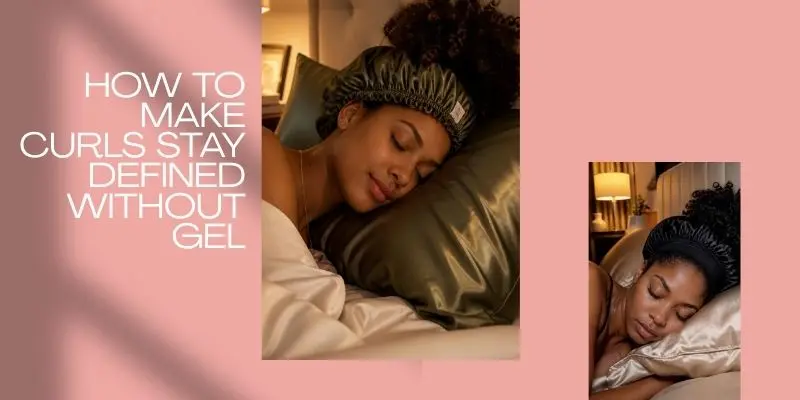
- Protect your curls overnight with a satin bonnet or pillowcase.
- Refresh curls with a light mist of water before applying more product.
- Use lighter styling layers during humid weather.
- Trim damaged ends regularly to maintain a healthy curl shape.
These habits cannot guarantee frizz-free curls in every climate, but they can help reduce friction, improve moisture retention, and preserve curl clumps for longer.
Common Mistakes That Make Curls Lose Definition
Even a good curly hair routine can produce disappointing results if a few common mistakes keep getting in the way.
- Brushing dry curls: Breaks apart curl clumps and may increase breakage.
- Using harsh shampoo too often: Cleanses away natural oils and leaves curls dry.
- Skipping clarifying washes: Product buildup can flatten your curl pattern.
- Applying too much oil or cream: Heavy products often stretch fine curls and waves.
- Skipping conditioner: Dry hair creates more friction and less definition.
- Drying with a rough towel: Use a microfiber towel or cotton T-shirt instead.
- Using high diffuser airflow: Strong airflow can separate curl clumps.
- Touching damp hair: Wait until your curls are fully dry before fluffing.
- Following someone else’s routine exactly: Your curl pattern, density, and porosity are unique.
- Sleeping without protecting your hair: Overnight friction can flatten curls and increase frizz.
If frizz is still your biggest challenge, focus on keeping your hair moisturized, drying it gently, and avoiding unnecessary friction. Small changes to your routine can make a noticeable difference over time.
No-Gel Curl Troubleshooting Guide
| Problem | Possible Cause | What to Try |
|---|---|---|
| Defined when wet but frizzy when dry | Too much movement while drying | Lower diffuser airflow and avoid touching your curls |
| Flat or heavy curls | Too rich a product | Clarify your hair and use less product or switch to mousse |
| Soft curls that lose shape quickly | Not enough hold | Add a lightweight mousse or styling lotion |
| Flat roots | Applying heavy products near the scalp | Keep creams away from the roots |
| White flakes | Too much product or incompatible formulas | Use one styler at a time and test product combinations |
| Straight ends | Hair damage, weight, or mixed curl pattern | Deep condition regularly and consider a trim |
| Slow drying | Thick hair or heavy product layers | Apply less product and diffuse in sections |
| Humidity frizz | Flexible hold is not enough | Try a lightweight anti-humidity mousse or styler |
My Practical Advice for Softer, More Defined Curls
One lesson I’ve learned is that adding more products doesn’t always create better curls. In many cases, a small amount of mousse or curl cream works better than layering several moisturizing products. When hair feels soft instead of overloaded, curl definition usually lasts longer.
I also recommend changing only one part of your routine at a time. For example, keep the same styling technique but replace your curl cream with a lightweight mousse. Small changes make it much easier to understand what your hair responds to best.
Remember that every curl pattern is different. If one method doesn’t work the first time perfectly, don’t get discouraged. Building a consistent curly hair routine and understanding your natural curl pattern will always give better long-term results than constantly switching products.
Share Your Curl Story
Every head of curls is unique, and what works for one person may not work for another. I’d love to hear about your experience.
Tell us:
- Your curl type (2, 3, or 4)
- Your hair porosity, if you know it
- Your favorite no-gel styling method
- The products that worked best for you
- The biggest challenge you’re trying to solve
Your experience could help another reader discover a routine that works for their curls.
How This Article Was Created
This guide was created using established curly hair care practices, cosmetic hair science, professional recommendations, and trusted educational resources. Hair care guidance was reviewed alongside information from organizations such as the American Academy of Dermatology (AAD) and published research on hair fibers and cosmetic science where appropriate.
Because every person’s hair is different, results will vary depending on curl pattern, porosity, hair density, strand thickness, product choice, styling technique, and environmental conditions. This article is intended for educational purposes and should not replace personalized advice from a qualified hairstylist or dermatologist if you have ongoing scalp or hair concerns.
Final Thoughts on Defining Curls Without Gel
Learning how to define curls without gel isn’t about finding one perfect product. It’s about understanding your hair, choosing lightweight products when needed, using gentle styling techniques, and protecting your curls as they dry.
Start with a simple routine, change only one step at a time, and give your hair a chance to respond before trying something new. Over time, you’ll discover the combination of moisture, styling techniques, and products that brings out your best natural curls.
Frequently Asked Questions
Yes. Curls can stay defined without traditional hair gel when you focus on moisture, styling technique, and gentle drying. Applying a lightweight mousse or curl cream to wet hair helps create soft, flexible hold, while scrunching or finger coiling encourages natural curl clumps. Once your curls are dry, protect them overnight with a satin bonnet or pillowcase to help maintain definition.
Good alternatives include mousse, styling foam, curl cream, and leave-in conditioner. Mousse provides lightweight hold and volume, curl cream creates soft definition, and leave-in conditioner adds moisture with minimal hold. The best choice depends on your curl pattern, hair density, and styling goals.
Start with clean, conditioned hair and detangle gently while it is still wet. Then use curl-enhancing techniques such as scrunching, finger coiling, shingling, or brush styling. Allow your hair to air-dry or diffuse on low airflow, and avoid touching your curls until they are completely dry.
Apply a lightweight mousse or styling lotion evenly through wet hair, shape your curl clumps, and dry your hair completely before fluffing. Limiting friction, avoiding frequent touching, and protecting your curls overnight can help them stay defined longer, although humidity and weather conditions will still have an effect.
Yes. Cleanse, condition, and detangle your hair before preserving the natural curl clumps with gentle scrunching. Micro-plop with a cotton T-shirt or microfiber towel, then air-dry or diffuse slowly. While product-free curls often feel softer and more natural, they usually lose definition faster than curls supported with lightweight styling products.
Yes. Water can help reactivate leftover styling products and encourage curl clumps to form again. Lightly mist flattened sections, reshape your curls with your fingers, and let them air-dry or diffuse gently. Water alone refreshes the curl pattern, but it usually doesn’t provide lasting hold.



- Be Respectful
- Stay Relevant
- Stay Positive
- True Feedback
- Encourage Discussion
- Avoid Spamming
- No Fake News
- Don't Copy-Paste
- No Personal Attacks
- Be Respectful
- Stay Relevant
- Stay Positive
- True Feedback
- Encourage Discussion
- Avoid Spamming
- No Fake News
- Don't Copy-Paste
- No Personal Attacks
