4C Hair Porosity Guide: How to Test and Care for Your Hair
Published: 13 Aug 2026
If your 4C hair sometimes feels dry even after moisturizing, or your products seem to sit on your strands instead of sinking in, you may be wondering what is going on. Hair porosity can help explain some of these differences, but it is not the only factor that affects how your hair behaves.
In this 4C Hair Porosity Guide, I’ll explain how low-, medium-, and high-porosity hair can behave, how to test your hair without relying on one simple test, and how to adjust your routine based on what your hair actually needs.
Remember, 4C describes your curl pattern, while porosity describes how your hair interacts with water and products. If you are still learning about your curl pattern and its needs, start with our Type 4C Hair guide. Your porosity is best treated as a helpful guide, not a permanent label.
What Is Hair Porosity for 4C Hair?
Hair porosity refers to how easily your hair absorbs and holds onto moisture. The outer layer of the hair shaft, called the cuticle, plays an important role in how water and other substances move into and out of the hair.
When the cuticle is more tightly packed, water and products may take longer to enter the hair. When the hair surface is more damaged or porous, moisture may enter more easily but can also escape more quickly.
This is one reason two people with 4C hair can have very different hair-care experiences. One person may struggle with product buildup, while another may find that their hair becomes dry again soon after moisturizing.
Porosity is also different from curl pattern. Your 4C classification describes the shape and tightness of your curls. It does not tell you whether your hair is low, medium, or high porosity.
Hair condition matters, too. Heat, chemical processing, repeated grooming, and environmental exposure can change the hair shaft and contribute to cuticle damage.
Does 4C Hair Have a Specific Porosity?
No, 4C hair does not have one specific porosity. 4C describes your curl pattern, while porosity describes how your hair absorbs and holds moisture. Two people with 4C hair can have different porosity levels.
No. 4C hair does not have one specific porosity.
Someone with 4C hair can have:
- Low porosity
- Medium porosity
- High porosity
Your hair may also behave differently from someone else with the same curl pattern. Previous heat or chemical treatments, bleaching, mechanical damage, and daily handling can affect the condition of the hair shaft.
That is why I would not choose products simply because they say they are made for “4C hair.” Your hair’s response is much more useful than a label alone.
The 3 Types of 4C Hair Porosity
4C hair can have low, medium, or high porosity, and each type may respond differently to water and hair products.
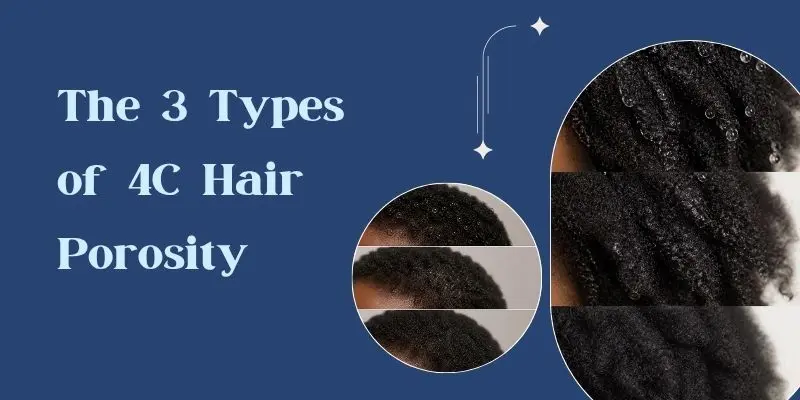
Learning how your hair behaves can help you build a routine that works better for you.
Low-Porosity 4C Hair
Low-porosity 4C hair may resist absorbing water and products quickly. You may notice that water seems to sit on the surface before your hair becomes fully wet.
Product buildup can also become a concern when you use several heavy products at once. Your hair may feel coated rather than moisturized.
A simple routine can help. Try lightweight, water-based moisturizing products and avoid layering too many products at the same time. Cleansing regularly can also help remove buildup.
Some people find that gentle warmth during conditioning makes the process feel more effective. The goal is not to force moisture into your hair but to make your routine easier for your hair to handle.
Medium-Porosity 4C Hair
Medium-porosity 4C hair often has a more balanced relationship with moisture. Water and products may absorb without feeling extremely slow or extremely fast.
This can make your routine easier to manage, but it does not mean you should ignore your hair’s response. Your hair can still become dry, overloaded with products, or damaged by excessive manipulation.
A balanced routine usually includes cleansing, conditioning, moisturizing, and gentle handling. You may not need to constantly switch products when your current routine is working well.
High-Porosity 4C Hair
High-porosity 4C hair may absorb water and products quickly, but it can also lose moisture more quickly. This may leave the hair feeling dry soon after washing or moisturizing.
High porosity can be a natural characteristic, but damage can also make the hair shaft more porous. Heat, bleaching, chemical treatments, and rough handling can affect the cuticle and hair structure.
Conditioning and gentle handling become especially important when your hair feels weak or dry. A leave-in conditioner or moisturizer may help, and some people benefit from sealing after moisturizing.
Protein treatments can also be useful for some damaged hair, but I would not treat protein as a universal requirement for every high-porosity head of hair. Your hair’s condition and response should guide that decision.
Signs of Low, Medium, and High Porosity 4C Hair
The following table shows general tendencies, not strict rules. Hair does not always fit perfectly into one category.
| Feature | Low Porosity | Medium Porosity | High Porosity |
|---|---|---|---|
| Water absorption | Often slower | Moderate | Often faster |
| Product absorption | Can be slower | Moderate | Often faster |
| Moisture retention | Often good | Usually balanced | Can be more difficult |
| Product buildup | More likely | Moderate | Varies |
| Drying time | May take longer | Moderate | May dry faster |
| Common concern | Buildup | Balance | Moisture loss |
Instead of trying to match every sign, look for patterns. How does your hair behave after washing? How quickly does it become dry? Do products sit on your strands? Does buildup happen easily?
Those observations can tell you more than one quick test.
How to Test 4C Hair Porosity
You can learn about your 4C hair porosity by paying attention to how your hair responds to water, products, and conditioning.
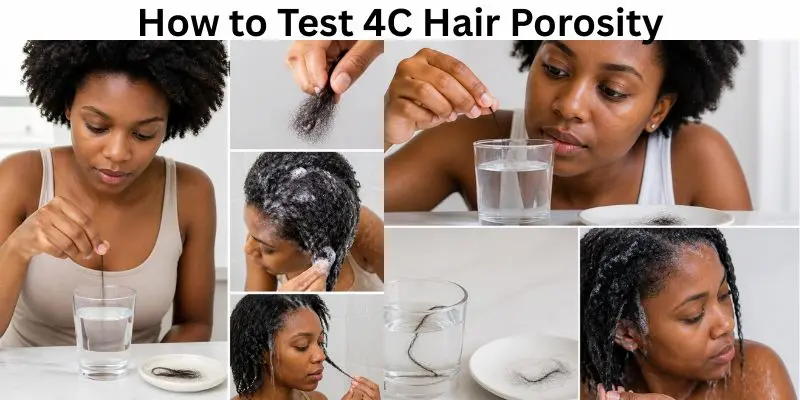
Popular tests can offer clues, but they should not be treated as a definite diagnosis.
The Float Test
The float test is one of the most popular home methods for checking hair porosity. It usually involves placing a clean strand of shed hair in water and observing whether it floats or sinks.
However, I would not use this test as a definite diagnosis.
Hair has different surface conditions, and factors such as product residue can affect how a strand behaves in water. Instead of making your entire routine depend on one result, combine the test with everyday observations.
Observe How Your Hair Absorbs Water
Pay attention the next time you wash your hair.
Does your hair become saturated quickly, or does it take a while for water to spread through your strands? Does your hair feel moisturized after washing, or does it become dry again soon afterward?
These observations can help you understand your hair’s behavior over time.
Pay Attention to Product Absorption
Your products can provide useful clues, too.
If a moisturizer seems to sit on top of your hair and leaves a coating, you may be dealing with buildup or slower absorption. On the other hand, if your hair seems to absorb products quickly but becomes dry again soon afterward, moisture retention may be a bigger concern.
This does not mean one product response proves your porosity. Look for repeated patterns.
Look at Your Hair’s Condition
Also consider the history of your hair.
Have you used heat frequently? Do you bleach or chemically process your hair? Do you detangle roughly or manipulate it often?
Repeated chemical treatments, grooming, and environmental exposure can contribute to hair-shaft damage and changes in porosity.
How to Care for Low-Porosity 4C Hair
If your low-porosity 4C hair struggles with buildup, keep your routine simple.
Choose lightweight, water-based moisturizing products when they work well for you. Avoid applying several heavy layers just because your hair feels dry.
Regular cleansing can help when buildup prevents products from working comfortably. During conditioning, gentle warmth may make the process more comfortable and effective for some people.
Most importantly, pay attention to your results. If a heavy butter makes your hair feel coated, you do not need to keep using it simply because it is popular for natural hair.
How to Care for Medium-Porosity 4C Hair
Medium-porosity 4C hair can often do well with a straightforward routine.
Cleanse regularly, condition your hair, and moisturize when it needs it. Use gentle detangling techniques and avoid unnecessary manipulation.
You also do not need to change your entire routine every time you see a new hair-care trend.
If your current products leave your hair comfortable, manageable, and properly conditioned, consistency may be more useful than constantly searching for something new.
How to Care for High-Porosity 4C Hair
With high-porosity 4C hair, moisture retention may deserve more attention.
Start with proper conditioning and consider a leave-in conditioner or moisturizer if your hair responds well to them. Some people also use an oil or butter to help seal moisture into the hair.
Gentle detangling matters because damaged or fragile hair can be more vulnerable to breakage. Limiting unnecessary heat and harsh chemical processing can also help protect the hair shaft. The American Academy of Dermatology recommends limiting practices that can weaken or damage hair, including excessive heat and tight styling.
If your hair feels weak, a protein-containing treatment may be worth considering, but there is no universal schedule that works for everyone.
Best Ingredients for 4C Hair by Porosity
The best ingredients can depend on how your 4C hair absorbs and retains moisture. Instead of choosing products based only on a porosity label, pay attention to how your hair responds after using them.
Ingredients for Low-Porosity 4C Hair
Look for lightweight, water-based moisturizing formulas when they suit your hair. Humectants and lightweight conditioning ingredients may be useful, but the complete formula matters more than one ingredient.
If heavy products consistently leave your hair coated, use them less often or choose lighter alternatives.
Ingredients for Medium-Porosity 4C Hair
Medium-porosity hair can often benefit from balanced conditioning and moisturizing ingredients.
Look for products that leave your hair soft and manageable without creating excessive buildup. A leave-in conditioner, moisturizer, and occasional oil can fit into a routine when your hair responds well to them.
For more product-selection ideas, see our guide to best products for 4C hair.
Ingredients for High-Porosity 4C Hair
High-porosity hair may benefit from richer conditioning and moisturizing formulas when they help reduce dryness.
Leave-in conditioners, hair moisturizers, oils, and butters can all have a place in a routine, depending on your hair’s needs. The goal is not to use the most products. It is to find a combination that helps your hair stay conditioned without becoming weighed down.
4C Hair Porosity and Moisture Retention
Moisture absorption and moisture retention are not the same thing. Your hair may absorb water quickly but still lose moisture quickly, which is why understanding both can help you adjust your 4C hair routine.
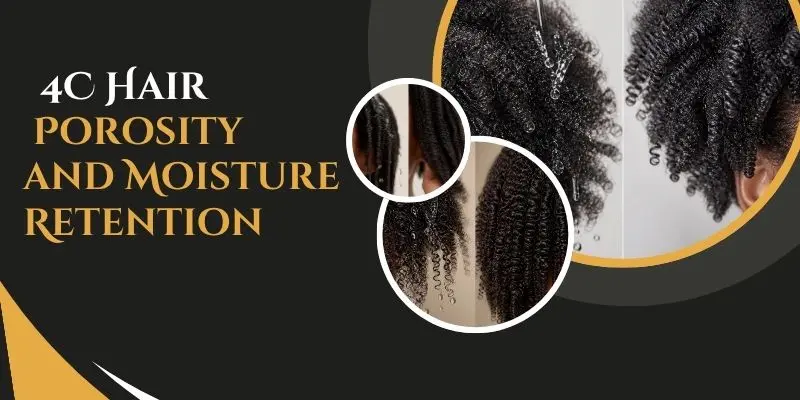
Moisture absorption and moisture retention are not the same thing.
Absorption describes how easily moisture enters the hair. Retention describes how well the hair holds onto that moisture.
This distinction matters for 4C hair. A strand may absorb water very quickly but still lose moisture quickly. That can leave your hair feeling dry even though it absorbs products easily.
On the other hand, hair that absorbs moisture slowly may still retain it well once it becomes properly moisturized.
If dryness is your main concern, our guide on how to moisturize 4C hair can help you build a more practical moisture routine.
4C Hair Porosity, Breakage, and Dryness
Porosity can be one piece of the puzzle when your 4C hair feels dry or becomes difficult to manage.
Dry-feeling strands may become harder to detangle, and rough handling during detangling can increase mechanical stress. Damaged hair can also be more prone to tangling and breakage.
However, I would not assume that porosity alone causes breakage.
Your routine, heat use, chemical processing, styling tension, detangling habits, and overall hair condition can all matter. Research on hair cosmetics shows that repeated chemical treatments and grooming practices can damage the cuticle and contribute to changes in hair strength and manageability.
Does Hair Porosity Change?
Your hair’s behavior can change over time, especially when its condition changes.
Heat styling, bleaching, chemical treatments, mechanical damage, and environmental exposure can affect the hair shaft and cuticle. Research has found that cosmetic treatments such as bleaching and thermal processing can alter hair structure and mechanical properties.
This is why I would not treat your porosity as a permanent identity.
Your natural hair may behave one way when it is healthy and untreated, then behave differently after repeated chemical processing or significant damage.
Instead of asking, “What is my porosity forever?” ask:
“How is my hair behaving right now?”
That question can lead to better routine decisions.
4C Hair Porosity and Protective Hairstyles
Porosity also matters when you place your hair into a protective style.
Braids, twists, cornrows, wigs, buns, and other low-manipulation styles can reduce daily handling, but they do not automatically protect your hair from damage.
Your hair still needs appropriate care underneath the style. You also need to consider tension, scalp comfort, moisture, and how gently you remove the style.
For more guidance on choosing and maintaining low-manipulation styles, see our guide to protective hairstyles for 4C hair.
If you wear a style for several days or weeks, avoid assuming that you can ignore your hair underneath it. Your scalp and hair still need attention.
Common 4C Hair Porosity Mistakes
Many people make hair-care decisions based on simple porosity rules that do not always match their actual hair behavior. Avoiding these common mistakes can help you create a more balanced and practical routine.
Assuming Every 4C Head Has the Same Porosity
4C is a curl pattern, not a porosity category. Two people with 4C hair can have very different moisture needs.
Using Too Many Products
More products do not automatically mean more moisture. Too many layers can create buildup and make your hair harder to manage.
Confusing Dryness With Low Porosity
Dryness does not automatically mean low porosity. Hair can feel dry for many different reasons.
Treating the Float Test as a Diagnosis
The float test can be a fun observation, but it should not decide your entire hair-care routine.
Ignoring Hair Damage
Hair that has been heavily processed or repeatedly exposed to heat may behave differently from healthy, untreated hair.
Choosing Products Only Because They Are “For 4C Hair”
A product made for 4C hair may still not work well for your individual strands.
Changing Your Routine Too Often
Give your routine enough time to show you how your hair responds. Constantly switching products can make it harder to understand what actually works.
How to Build a 4C Hair Routine Based on Porosity
Instead of following a strict porosity chart, use this simple process:
1. Observe how your hair behaves.
Notice how quickly it absorbs water, products, and moisture.
2. Consider your hair’s condition.
Think about heat, chemicals, bleaching, and mechanical damage.
3. Choose a cleansing routine.
Cleanse enough to keep your scalp and hair comfortable without unnecessary buildup.
4. Choose a conditioner.
Use a conditioner that leaves your hair soft and manageable.
5. Add moisture.
Use a moisturizer or leave-in conditioner when your hair needs it.
6. Seal if needed.
If your hair loses moisture quickly, an oil or butter may help your routine.
7. Monitor your results.
Look at how your hair feels between wash days rather than focusing only on labels.
8. Adjust based on your hair’s response.
If something causes buildup, dryness, or poor manageability, change your approach.
For readers who prefer co-washing, you can also learn how to co-wash 4C hair and decide whether that approach fits your routine.
The most useful porosity routine is not necessarily the most complicated one. It is the one that helps you understand and respond to your hair.
Submit Your Story
Have you learned something useful about caring for your 4C hair after figuring out its porosity? Submit your story and share what worked for your hair, what did not, or what you wish you had known sooner. Your experience may help another reader better understand their own 4C hair and build a routine that works for them.
Conclusion
Understanding your 4C hair porosity guide can make your routine easier, but you do not need to follow a strict set of rules.
4C hair can have low, medium, or high porosity. Your hair’s condition, styling habits, products, and daily handling can also affect how it behaves.
Rather than chasing a perfect porosity label, pay attention to your hair. Notice how it absorbs moisture, how long that moisture lasts, whether buildup develops, and how easily your strands stay manageable.
With gentle handling, consistent conditioning, appropriate moisture, and a willingness to adjust your routine, you can make better choices for your individual 4C hair.
Frequently Asked Questions
There is no single “best” porosity for 4C hair. Low, medium, and high porosity can all occur in 4C hair. What matters most is how your hair behaves and what it needs. Your routine should focus on moisture, conditioning, gentle handling, and healthy hair practices. Porosity is a guide, not a measure of whether your hair is good or bad.
Start by observing how your hair behaves with water and products. Notice whether your hair absorbs water slowly or quickly and whether products sit on the strands or absorb easily. Also consider buildup, dryness, and moisture retention. The float test can provide a clue, but it should not be treated as a definitive diagnosis. Looking at several patterns gives you a more useful picture.
4C hair is not automatically low or high porosity. You can have low-, medium-, or high-porosity 4C hair. Your hair’s condition can also influence how porous it behaves. Heat, bleaching, chemical processing, and mechanical damage may affect the hair shaft. Instead of assuming your porosity based on your curl type, observe how your own hair responds.
Start with water-based moisturizing products that your hair absorbs comfortably. Avoid applying too many heavy products at once if they leave your hair coated or cause buildup. Cleansing can help remove excess product, while conditioning with gentle warmth may be helpful for some people. Most importantly, watch your hair’s response. If a product consistently creates buildup, it may not be the right choice for your routine.
Your hair’s behavior can change when its condition changes. Heat, bleaching, chemical treatments, environmental exposure, and repeated mechanical stress can affect the hair shaft and cuticle. This means you may notice different moisture and product responses over time. Instead of treating porosity as a permanent label, reassess your hair when your routine or hair condition changes. That makes your routine more flexible and realistic.
How This Article Was Created
This article was developed using established information about hair structure, hair-shaft damage, cosmetic hair care, and practical natural-hair care principles. Research on hair cosmetics supports the role of the cuticle in hair behavior and shows that repeated chemical treatments, heat, grooming, and environmental exposure can affect the hair shaft.
The practical recommendations in this guide are presented as general hair-care guidance rather than a diagnosis or a universal prescription. Your hair’s response should always help guide your routine.






- Be Respectful
- Stay Relevant
- Stay Positive
- True Feedback
- Encourage Discussion
- Avoid Spamming
- No Fake News
- Don't Copy-Paste
- No Personal Attacks
- Be Respectful
- Stay Relevant
- Stay Positive
- True Feedback
- Encourage Discussion
- Avoid Spamming
- No Fake News
- Don't Copy-Paste
- No Personal Attacks
