Cedarwood Oil for Hair: Benefits, Uses & Safety
Published: 17 Aug 2026
Cedarwood oil has become a popular ingredient in natural hair-care routines, especially among people interested in scalp care, hair oiling, and healthier-looking hair. You may have seen claims that cedarwood oil for hair can support hair growth, reduce shedding, or help with dandruff.
But there is an important difference between an interesting natural ingredient and a proven hair-loss treatment.
Research on cedarwood oil for hair is limited. One frequently cited human study investigated a blend containing cedarwood, rosemary, thyme, and lavender oils in people with alopecia areata. Because several oils were used together, the study cannot show that cedarwood oil alone caused the improvement.
So, is cedarwood oil worth trying? It can be an optional part of a carefully planned scalp-care routine, but I would not treat it as a guaranteed hair-growth solution.
In this guide, I’ll explain the potential cedarwood oil benefits, what the research actually shows, how to use it safely, which carrier oils you can consider, and when hair loss needs professional attention.
Quick Answer: Is Cedarwood Oil Good for Hair?
Cedarwood oil may fit into a scalp-care or hair-oiling routine when used properly, but there is not enough strong evidence to show that cedarwood essential oil alone causes hair regrowth.
The most relevant human study tested cedarwood together with rosemary, thyme, and lavender oils rather than cedarwood alone. Therefore, its results cannot be used as proof that cedarwood by itself grows hair.
If you choose to use cedarwood essential oil topically, use a properly diluted product and stop if you develop irritation or an allergic reaction. Essential oils can cause skin irritation and allergic contact dermatitis in some people.
What Is Cedarwood Oil?
Cedarwood essential oil is a concentrated aromatic oil obtained from trees commonly called cedar. However, the word cedarwood can refer to oils from different plant species.
True cedars belong to the Cedrus genus, while some products sold as cedarwood oil come from other genera, such as Juniperus.
This matters because different plant sources can produce oils with different chemical compositions.
For that reason, I recommend checking the botanical name on the product label rather than assuming every cedarwood essential oil is chemically identical.
Common Cedarwood Species
You may see cedarwood products associated with species such as:
- Cedrus species
- Cedrus atlantica, commonly known as Atlas cedar
- Juniperus virginiana, commonly known as Virginia or eastern red cedar
The exact composition can vary depending on the plant source, growing conditions, extraction method, and other factors.
What Compounds Are Found in Cedarwood Oil?
Depending on its botanical source, cedarwood oil can contain compounds such as:
- Cedrol
- Cedrene
- Thujopsene
These compounds contribute to cedarwood’s characteristic woody aroma.
However, finding a particular compound in an essential oil does not prove that the complete oil will stimulate human hair growth.
That distinction is important when evaluating natural hair-care claims.
Cedarwood Essential Oil vs. Cedarwood Hair Oil
These two products are not necessarily the same.
Cedarwood essential oil is highly concentrated and is normally used in a diluted form.
A cedarwood hair oil may already contain a carrier oil such as jojoba, coconut, grapeseed, or argan oil.
Always check the ingredient list before applying a product to your scalp to know exactly what you are using.
7 Potential Cedarwood Oil Benefits for Hair and Scalp
Cedarwood oil is promoted online for several hair and scalp benefits. However, the strength of evidence varies considerably.
Some potential benefits are based on general properties of essential oils or traditional use rather than strong human hair research.
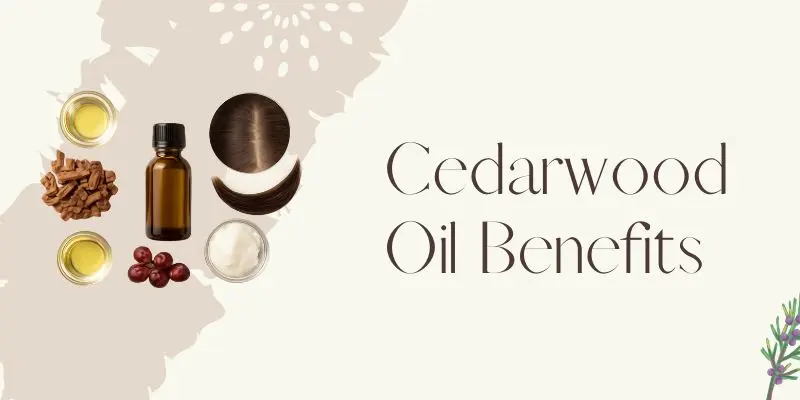
Here are the most reasonable ways to look at cedarwood oil.
1. May Support a Simple Scalp-Care Routine
A comfortable, well-maintained scalp is an important part of overall hair care.
Cedarwood essential oil contains naturally occurring compounds that have been studied for biological activity. However, this does not mean that applying cedarwood oil to the scalp has been proven to improve scalp health or hair growth in humans.
I would therefore view cedarwood as an optional scalp-care ingredient, not a proven treatment for scalp disorders.
If you are interested in another essential oil commonly used in hair-care routines, you can also read about rosemary oil for hair.
2. May Be Suitable for an Oily Scalp Routine
If your scalp becomes greasy quickly, it can be tempting to look for an oil that will “balance” sebum production.
Sebum is the natural oil produced by the skin, and it helps protect the scalp and hair.
Cedarwood oil is sometimes promoted as a scalp-balancing ingredient, but there is not enough good human evidence to say that it reliably reduces sebum production.
If your scalp becomes oily quickly, an appropriate cleansing routine may be more important than adding another oil.
3. May Complement a Flake-Free Scalp Routine
Essential oils are often discussed for their antimicrobial properties, which is one reason cedarwood appears in natural scalp-care routines.
However, flaking can have several causes.
Dandruff, dry skin, irritation, and other scalp conditions can produce similar symptoms.
For persistent dandruff, itching, redness, or scaling, I would not rely on cedarwood oil alone. A targeted treatment may be more appropriate.
If your scalp feels mainly dry, you may also find my guide to dry scalp treatments at home useful.
4. May Make a Dry Scalp or Hair Feel More Comfortable
Cedarwood essential oil itself should not be confused with a moisturizer.
A carrier oil used to dilute cedarwood can provide lubrication and may make the hair or scalp feel less dry.
Common carrier oils include:
- Jojoba oil
- Coconut oil
- Grapeseed oil
- Argan oil
If you notice a softer feel after an oil treatment, some of that effect may come from the carrier oil rather than cedarwood itself.
5. May Complement a Healthy Scalp Environment
Hair follicles are located within the scalp, so basic scalp care is naturally part of a healthy hair routine.
However, it is important not to turn this idea into an unsupported claim that cedarwood oil “activates” dormant follicles.
There is currently not enough evidence to say that cedarwood essential oil directly increases hair density or reliably stimulates new hair growth.
6. May Fit Into a Hair-Growth Routine
Some people enjoy combining scalp massage with hair oiling.
The important thing is to distinguish between supporting a hair-care routine and treating hair loss.
If you notice less breakage or healthier-looking hair after improving your routine, that does not necessarily mean cedarwood caused new hair growth.
For a broader comparison of oils commonly discussed for hair growth, see my guide to best essential oils for hair growth.
7. May Make Hair Feel Softer When Used With a Carrier Oil
The carrier oil in a cedarwood hair treatment can help reduce friction and make hair feel smoother.
For example:
- Coconut oil can provide a richer oiling experience.
- Grapeseed oil has a lighter feel.
- Jojoba oil is often chosen for its lighter texture.
- Argan oil can work well in a conditioning-focused routine.
The conditioning effect should not automatically be attributed to cedarwood essential oil.
Does Cedarwood Oil Really Help Hair Growth?
This is the question most people have when searching for cedarwood oil for hair growth.
The honest answer is simple:
There is not enough strong evidence to show that cedarwood essential oil alone causes human hair regrowth.
What Does the Research Show?
A frequently cited randomized controlled trial published in 1998 involved people with alopecia areata.
The study included 86 participants. The active treatment used a mixture of:
- Thyme essential oil
- Rosemary essential oil
- Lavender essential oil
- Cedarwood essential oil
- Jojoba oil
- Grapeseed oil
The control group used only the carrier oils. The treatments were massaged into the scalp daily.
Among participants who completed the study, the active group showed more improvement than the carrier-oil group.
That result is interesting, but it needs to be interpreted carefully.
Why the Study Does Not Prove Cedarwood Oil Alone Grows Hair
The participants did not use cedarwood oil by itself.
They used four essential oils together:
- Cedarwood
- Rosemary
- Thyme
- Lavender
They also used jojoba and grapeseed oils and performed scalp massage.
Therefore, the study cannot tell us which ingredient contributed to the result.
It also cannot tell us whether the combination, massage, or other factors played a role.
This is why it would be inaccurate to write:
“Cedarwood oil has been proven to regrow hair.”
A more accurate statement is:
One older study found an improvement with a multi-oil aromatherapy blend that included cedarwood, but it did not establish cedarwood oil as a standalone hair-growth treatment.
What Research Is Still Needed?
Better studies would need to test cedarwood oil alone, use appropriate controls, include enough participants, and measure meaningful hair-growth outcomes.
Until then, cedarwood oil for hair growth should be considered an interesting but unproven option.
My Honest Take
If you enjoy natural hair care, a properly diluted cedarwood oil product may be something you choose to try.
But I would not rely on it to treat significant thinning, bald patches, or unexplained shedding.
Hair loss can have many causes, including hereditary factors, certain medical conditions, medications, nutritional issues, and hair-care practices. Finding the underlying cause is much more important than repeatedly trying different oils.
Cedarwood Oil for Different Scalp Types
Not every scalp responds to oils in the same way. I find it helpful to consider whether your scalp is oily, dry, flaky, or sensitive before adding cedarwood oil to your routine.
Cedarwood Oil for an Oily Scalp
If your scalp becomes oily quickly, use a small amount of diluted oil rather than coating the scalp heavily.
Heavy oiling may leave buildup and make your roots feel greasy.
A suitable cleansing routine is usually more important than trying to control oiliness with another oil.
Cedarwood Oil for a Dry Scalp
A carrier oil may provide lubrication and make a dry scalp or hair feel more comfortable.
However, cedarwood essential oil itself is not a moisturizer.
If your scalp is persistently dry, itchy, red, or flaky, consider whether another scalp condition may be responsible.
Cedarwood Oil for a Flaky Scalp
Do not assume every flake is caused by dryness.
Dandruff and other scalp conditions can cause persistent flakes and itching. Cedarwood oil should not replace a targeted treatment when symptoms continue.
Cedarwood Oil for a Sensitive or Itchy Scalp
Extra caution is needed if your scalp is already sensitive or irritated.
Essential oils can cause irritation or allergic reactions in some people. If your scalp is damaged, inflamed, or reacting to another product, avoid adding cedarwood until the problem has settled or has been properly evaluated.
How to Use Cedarwood Oil for Hair
If you want to try cedarwood oil for hair, the safest approach is to use it properly diluted and keep your routine simple.
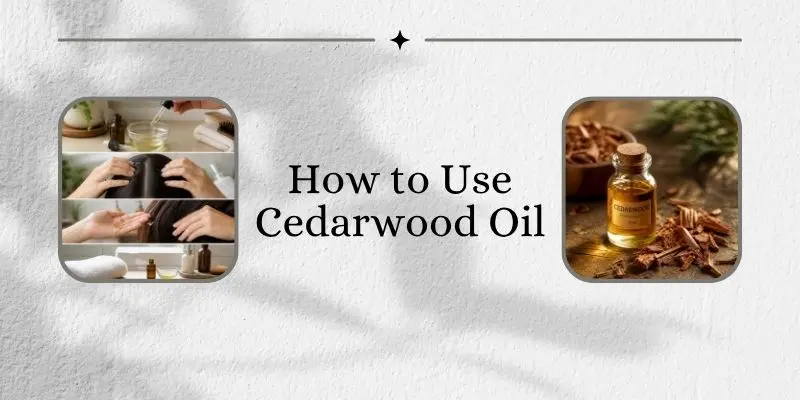
Start with a small amount, apply it gently to the scalp, and always check how your skin responds before regular use.
1. Use a Properly Diluted Cedarwood Oil
Do not treat concentrated cedarwood essential oil like a normal hair oil.
Essential oils are highly concentrated. Topical use should follow an appropriate dilution recommended by the product manufacturer or a qualified professional.
2. Mix Cedarwood Oil With a Carrier Oil
Common carrier oils include:
- Jojoba oil
- Coconut oil
- Grapeseed oil
- Argan oil
The carrier oil helps dilute the essential oil and provides the base for a scalp-oiling treatment.
3. Use It as a Pre-Shampoo Treatment
A pre-shampoo treatment can be a simple way to include diluted cedarwood oil in a hair-oiling routine.
Apply a small amount to the scalp, massage gently, and leave it on according to the product directions.
You do not need to soak your scalp in oil.
4. Try a Gentle Scalp Massage
Use your fingertips instead of your nails.
Massage gently without scratching or applying excessive pressure.
Scalp massage can make an oiling routine more enjoyable, but it should not be presented as proof that cedarwood stimulates new hair growth.
Step-by-Step Application
- Start with a properly diluted cedarwood oil product.
- Patch test it before wider use.
- Apply a small amount to the scalp.
- Massage gently with your fingertips.
- Follow the product’s recommended contact time.
- Shampoo afterward if needed.
- Stop using it if burning, itching, redness, swelling, or another reaction develops.
Best Carrier Oils to Mix With Cedarwood Oil
Cedarwood essential oil should not be applied directly to the scalp. Mixing it with a suitable carrier oil can make application gentler while also adding conditioning benefits to your hair-care routine.
Cedarwood Oil + Jojoba Oil
Jojoba oil has a relatively light feel and may suit people who dislike heavy oil treatments.
Cedarwood Oil + Coconut Oil
Coconut oil is a richer option and may work well as part of a pre-shampoo treatment. However, it can feel heavy on fine hair.
If you already use coconut oil as part of your routine, you may also want to read about using coconut oil on your scalp at night.
Cedarwood Oil + Grapeseed Oil
Grapeseed oil has a lighter texture and may be a practical choice if you dislike thick oils.
Cedarwood Oil + Argan Oil
Argan oil is another option for a conditioning-focused hair-care routine.
There is no scientifically proven best carrier oil for hair growth. The best choice depends on your hair, scalp, product formulation, and personal preference.
How Often Should I Use Cedarwood Oil for Hair?
There is no strong clinical evidence showing that using cedarwood oil a specific number of times per week produces hair growth.
For that reason, I would not recommend an aggressive daily routine simply because a product promises faster results.
Start conservatively and follow the directions of the product you are using.
Pay attention to your scalp. If you develop itching, burning, redness, soreness, or increased flaking, stop using the product.
Can I Leave Cedarwood Oil on My Hair Overnight?
Overnight oiling is popular in many hair-care routines, but it is not proven to make cedarwood oil more effective for hair growth.
Longer exposure also means more time for your skin to react to an essential oil.
If you have a sensitive scalp, I would be especially cautious about overnight use.
A shorter treatment can be a more sensible way to see how your scalp responds.
Cedarwood Oil for Different Hair Types
Your hair type can affect how you use oils and how much your strands can handle. Cedarwood oil does not change your natural hair texture, but the carrier oil and application method can make a big difference in how your hair feels.
Cedarwood Oil for Fine Hair
Use a small amount of carrier oil because too much can make fine hair look flat or greasy.
Cedarwood Oil for Thick Hair
Thicker hair may tolerate a richer oiling routine, but there is still no need to saturate the scalp.
Cedarwood Oil for Curly Hair
Curly hair can benefit from a routine that supports softness and reduces unnecessary manipulation.
A carrier oil may improve the feel of the hair, but cedarwood essential oil does not replace conditioner or moisture.
Cedarwood Oil for Coily Hair
For coily hair, the overall moisture and conditioning routine is more important than adding one essential oil.
Avoid assuming that more oil automatically means more moisture.
Cedarwood Oil for 4A, 4B, and 4C Hair
Cedarwood oil does not change your natural curl pattern.
If you have 4A, 4B, or 4C hair, focus on gentle handling, adequate conditioning, moisture, and protection from excessive friction and breakage.
Cedarwood Oil for Hair Loss and Thinning Hair
Hair shedding and hair loss are not always the same thing.
Some shedding is part of the normal hair cycle. However, persistent shedding, thinning, reduced hair density, or bald patches can have different causes.
Possible causes include:
- Hereditary hair loss
- Alopecia areata
- Certain medical conditions
- Some medications
- Nutritional problems
- Hair-care practices
- Physical or emotional stress
Because the cause matters, persistent or sudden hair loss should not be treated with cedarwood oil alone.
What About Alopecia Areata?
Alopecia areata is an autoimmune condition that can cause sudden, patchy hair loss.
The 1998 aromatherapy study included people with alopecia areata and used a blend containing cedarwood, rosemary, thyme, and lavender.
However, the study did not test cedarwood alone.
Therefore, cedarwood oil should not be described as a proven treatment or cure for alopecia areata.
When Should I See a Dermatologist?
Consider professional evaluation if you notice:
- Sudden hair loss
- Smooth bald patches
- Rapidly increasing thinning
- Persistent excessive shedding
- Significant scalp inflammation
- Pain or sores
- Severe itching or scaling
- Hair loss affecting the eyebrows or eyelashes
A dermatologist can help identify the cause and recommend appropriate treatment.
For a broader resource, you can also read this hair loss guide.
Cedarwood Oil Safety and Side Effects
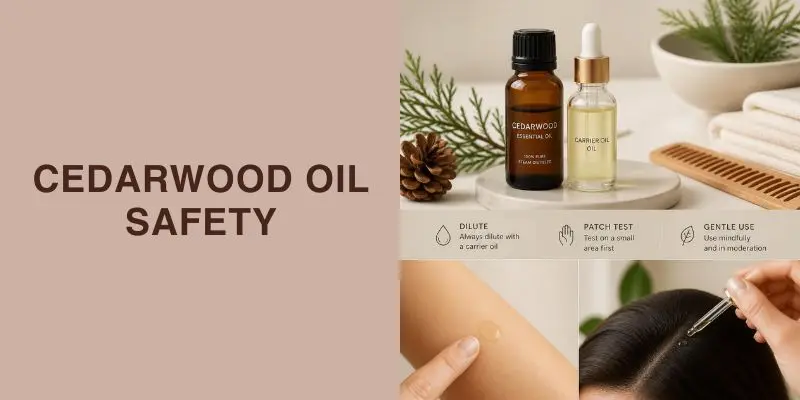
Natural does not always mean risk-free. Because cedarwood is an essential oil, I think safety should come before any potential hair or scalp benefit, especially if you have sensitive skin.
Can Cedarwood Oil Irritate the Scalp?
Yes.
Essential oils are concentrated substances, and topical exposure can irritate some people.
Stop using the product if you develop burning, redness, itching, scaling, or other unusual symptoms.
Can Cedarwood Oil Cause an Allergic Reaction?
Yes.
Some people can develop allergic contact dermatitis after exposure to essential oils or fragrance ingredients.
A reaction may cause symptoms such as itching, redness, swelling, or scaling.
Why Shouldn’t I Apply Cedarwood Oil Directly to My Scalp?
Concentrated essential oil is much stronger than a diluted hair-oil mixture.
Applying it directly can increase the risk of irritation.
A properly diluted product is a more appropriate option for topical use.
Should I Patch Test Cedarwood Oil?
A cautious patch test can help you identify an obvious reaction before applying a product more widely.
However, a patch test cannot guarantee that you will never develop an allergy or irritation later.
Who Should Be Especially Careful?
Take extra care if you have:
- Sensitive skin
- An already irritated scalp
- A damaged scalp
- A history of fragrance reactions
- A known essential-oil allergy
If you already have a scalp condition, it is better to understand the cause before adding more active or fragranced ingredients.
Common Mistakes People Make With Cedarwood Oil
Here are the mistakes I would avoid:
- Applying undiluted essential oil
- Using too much oil
- Skipping a patch test
- Expecting overnight hair growth
- Using cedarwood instead of investigating significant hair loss
- Mixing several essential oils without understanding their concentrations
- Continuing after scalp irritation appears
- Assuming “natural” automatically means risk-free
- Confusing essential oil with carrier oil
- Buying a product without checking its ingredients and botanical name
Cedarwood Oil vs. Rosemary Oil for Hair Growth
Rosemary oil has received more attention in hair-growth research, but that does not make it a guaranteed treatment.
| Feature | Cedarwood Oil | Rosemary Oil |
|---|---|---|
| Hair-growth evidence | Limited | More promising but still developing |
| Scalp use | Common | Common |
| Evidence quality | Limited | More human research available |
| Dilution needed | Yes | Yes |
| Proven replacement for medical treatment | No | No |
I would use this comparison to set expectations rather than declare a winner.
Neither oil should replace professional evaluation when someone has significant hair loss.
For a deeper look at rosemary, you can read my guide to rosemary oil for hair.
How to Choose a Good Cedarwood Essential Oil
When shopping for cedarwood essential oil for hair, check the label before focusing on marketing claims.
Look for:
- A clearly listed botanical name
- Ingredient transparency
- A reputable manufacturer
- Suitable packaging
- Batch or quality information when available
- Clear directions for use
- No unnecessary fillers
The botanical name is especially useful because “cedarwood” can refer to oils from different tree genera with different chemical profiles.
Also remember that a label saying “100% pure” by itself does not prove that a product is high quality or suitable for your scalp.
Cedarwood Oil Hair Treatment Ideas
If you want to try cedarwood oil, keeping the routine simple is usually the best approach. Below are a few practical ways to include properly diluted cedarwood oil in a hair-care routine without overloading your scalp or hair.
Diluted Cedarwood Scalp Massage
Use a properly diluted cedarwood oil product and gently massage a small amount into the scalp.
Best for: People who enjoy scalp massage as part of their hair-care routine.
Safety: Never apply concentrated essential oil directly to the scalp.
Pre-Shampoo Cedarwood Oil Treatment
Apply a small amount of diluted oil before washing.
Best for: People who already enjoy hair oiling.
Safety: Stop if your scalp becomes irritated.
Cedarwood and Jojoba Oil
Jojoba can provide a lighter-feeling carrier for a diluted cedarwood treatment.
Best for: People who dislike heavy oils.
Cedarwood and Grapeseed Oil
Grapeseed oil can provide another lightweight carrier option.
Best for: People who prefer a less greasy feel.
None of these treatments should be described as guaranteed hair-growth treatments. If you enjoy comparing different natural oils, you can also explore Neem oil for hair.
Cedarwood Oil: What It Can and Cannot Do
| Cedarwood Oil May Support | Cedarwood Oil Cannot Be Promised to Do |
|---|---|
| A simple scalp-care routine | Cure hair loss |
| A healthy hair-care routine | Guarantee hair regrowth |
| Hair oiling | Reverse every type of thinning |
| Conditioning when used with a carrier oil | Replace medical treatment |
| A pleasant woody aroma | Permanently change hair texture |
This is the most realistic way to think about cedarwood oil. It may have a place in personal hair care, but marketing claims can go much further than the available evidence. If you are exploring other essential oils, you can also read about tea tree oil for hair, lavender oil for hair,
Final Verdict: Is Cedarwood Oil Worth Trying for Hair?
I think cedarwood oil for hair is best viewed as an optional scalp-care ingredient rather than a proven hair-growth treatment.
It has some interesting properties, and one human study found benefits from an essential-oil blend that included cedarwood. However, because that study used several oils together, we cannot say that cedarwood alone caused the improvement.
If you want to try cedarwood essential oil, keep the routine simple. Use a properly diluted product, choose a suitable carrier oil, patch test first, and stop if your scalp reacts.
Most importantly, do not let a natural-oil routine delay proper care for unexplained hair loss. Sudden or patchy hair loss can have medical causes, and a dermatologist can help identify the underlying cause.
For me, the most useful way to think about cedarwood oil is this:
It may complement a good hair-care routine, but it should not be expected to replace a proven hair-loss treatment.
Frequently Asked Questions
There is not enough strong evidence to show that cedarwood essential oil alone makes human hair grow faster. One older study found improvement with a blend containing cedarwood, rosemary, thyme, and lavender oils, but it did not isolate cedarwood. Therefore, cedarwood should not be presented as a proven hair-growth treatment.
The evidence is limited. Cedarwood was included in one aromatherapy blend studied for alopecia areata, but that research does not prove that cedarwood oil alone treats hair loss. If you have sudden, patchy, or persistent hair loss, identifying the underlying cause is more important than relying on an essential oil.
It is better not to apply concentrated cedarwood essential oil directly to your scalp. Essential oils are highly concentrated and can cause irritation or allergic reactions. Use a properly diluted product and follow the manufacturer’s directions. Stop using it if you develop burning, redness, itching, swelling, or another reaction.
There is no scientifically proven best carrier oil for hair growth. Jojoba, coconut, grapeseed, and argan oils are common options. Your hair type, scalp condition, and preferred texture can help you choose one. The carrier oil should be used to properly dilute the cedarwood essential oil before topical application.
Yes, properly diluted cedarwood oil can be included in a 4C hair-care routine if your scalp tolerates it. However, it does not change your curl pattern or guarantee hair growth. Focus on moisture, conditioning, gentle handling, and reducing breakage. Always stop if the scalp becomes irritated.
How This Article Was Created
This guide was developed by reviewing scientific literature and dermatology guidance related to cedarwood oil, essential-oil safety, scalp care, and hair loss.
I separated established information from traditional uses and popular hair-growth claims. In particular, the research involving a cedarwood-containing aromatherapy blend was not presented as proof that cedarwood oil alone can regrow hair.
This article is for educational purposes and does not diagnose or treat individual scalp or hair-loss conditions.
Sources & References
National Center for Complementary and Integrative Health. Aromathera
Hay IC, Jamieson M, Ormerod AD. Randomized Trial of Aromatherapy: Successful Treatment for Alopecia Areata. Archives of Dermatology, 1998.
American Academy of Dermatology. Hair Loss: Overview.
American Academy of Dermatology. Alopecia Areata: Causes.
American Academy of Dermatology. Alopecia Areata: Diagnosis and Treatment.
DermNet. Allergic Contact Dermatitis to Essential Oils.





- Be Respectful
- Stay Relevant
- Stay Positive
- True Feedback
- Encourage Discussion
- Avoid Spamming
- No Fake News
- Don't Copy-Paste
- No Personal Attacks
- Be Respectful
- Stay Relevant
- Stay Positive
- True Feedback
- Encourage Discussion
- Avoid Spamming
- No Fake News
- Don't Copy-Paste
- No Personal Attacks
