Thyme Oil for Hair: Benefits, Uses & Hair Growth
Published: 1 Sep 2026
Can thyme oil for hair really support hair growth, or is it simply another natural remedy making big promises online?
If you have been dealing with hair thinning, shedding, dandruff, or an unhappy scalp, I understand why natural oils can sound appealing. They are easy to find and simple to add to a hair-care routine.
Thyme oil is especially interesting because it contains compounds that have been studied for antimicrobial activity, and thyme has also appeared in research involving essential-oil aromatherapy for alopecia areata. However, there is an important detail: that study used thyme together with rosemary, lavender, and cedarwood oils. It did not test thyme oil alone.
If you’re interested in comparing thyme with other natural options, you can also explore our guide to the best essential oils for hair growth.
So, what can thyme oil realistically do for your hair and scalp? Let’s look at the potential benefits, research, safe use, side effects, and what to consider before buying a thyme oil product.
What Is Thyme Oil?
Thyme oil is an essential oil derived from thyme plants, including Thymus vulgaris. The European Medicines Agency identifies thyme oil as the essential oil obtained from Thymus vulgaris or Thymus zygis.
Thyme contains naturally occurring compounds such as thymol and carvacrol. These compounds are part of the reason thyme oil has attracted scientific interest.
It is also important to distinguish thyme essential oil from thyme-infused hair oil.
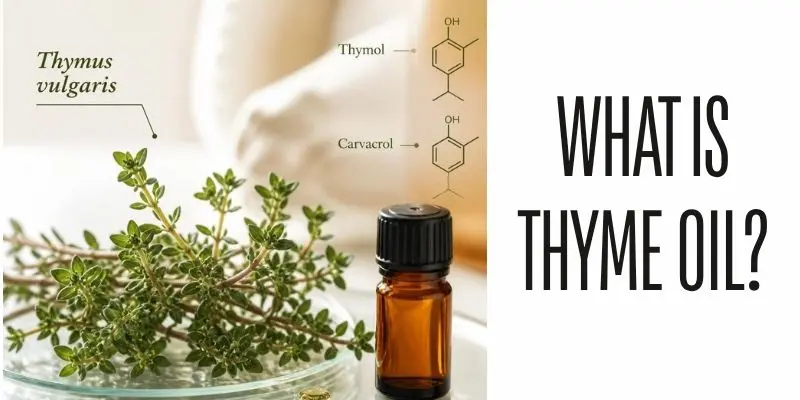
Essential oil is highly concentrated. A thyme-infused oil is usually a carrier oil that has been infused with thyme. They are not the same product and should not automatically be used in the same way.
If you are using thyme essential oil on your scalp, proper dilution matters.
Is Thyme Oil Good for Hair?
Thyme oil may be useful as a complementary scalp-care ingredient, but there is not enough evidence to say that thyme oil alone reliably promotes hair growth.
The strongest human hair-loss evidence involving thyme comes from an older clinical trial that studied an essential-oil blend containing thyme, rosemary, lavender, and cedarwood. Because several oils were used together, the results cannot tell us whether thyme itself produced the observed improvement.
Thyme oil’s antimicrobial properties may also make it interesting for scalp-care research. However, laboratory findings do not automatically mean that applying thyme oil to your scalp will treat a particular scalp condition. The EMA notes that much of the evidence surrounding thyme oil’s medicinal properties is limited, with some uses based on traditional rather than well-established clinical evidence.
For that reason, I would view thyme oil as a potential hair-care ingredient, not a proven hair-loss treatment.
7 Potential Benefits of Thyme Oil for Hair
Thyme oil is often added to natural hair-care routines because of its potential scalp and hair benefits. Some of its plant compounds have been studied for antimicrobial activity. However, research on thyme oil and hair growth is still limited. Here are seven potential benefits to know before adding it to your routine.
1. May Support Scalp Care
A healthy scalp is an important part of a good hair-care routine.
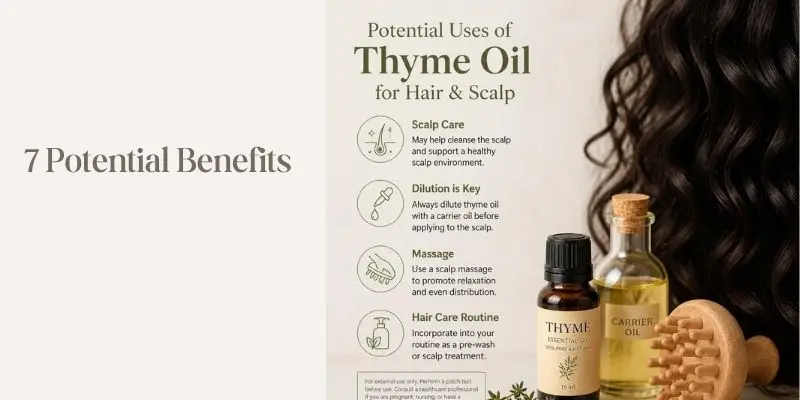
Thyme oil contains plant compounds that have been studied for antimicrobial activity. This makes it an interesting ingredient for scalp-focused products.
Still, that does not mean thyme oil can treat every scalp problem. Persistent itching, redness, sores, or scaling may have causes that require proper diagnosis.
2. Contains Compounds With Antimicrobial Activity
Thymol and carvacrol are two notable compounds found in thyme oil.
Research has examined thyme oil for antimicrobial activity, including laboratory research considered by the European Medicines Agency. However, laboratory activity is not the same as proving that a product treats a scalp infection in humans.
This distinction is important when evaluating natural hair remedies.
3. May Be Used in Essential-Oil Scalp Blends
The best-known hair-loss study combined thyme, rosemary oil for hair, lavender, and cedarwood oils with jojoba and grapeseed carrier oils. If you want to learn more about the individual oils used in natural hair-care routines, you can also explore our guides to Rosemary Oil for Hair and Lavender Oil for Hair.
This suggests an interesting area for further research, but it does not prove that thyme oil alone has the same effect.
4. Can Be Part of a Healthy Hair-Care Routine
A properly formulated scalp oil can fit into a broader hair-care routine.
Your routine should still include gentle cleansing, conditioning, careful detangling, and styling practices that minimize unnecessary tension and breakage.
Thyme oil should be viewed as one optional ingredient rather than the foundation of healthy hair care.
5. May Be Considered for Dandruff-Related Scalp Care
Thyme oil is sometimes promoted as a natural option for dandruff because of its antimicrobial properties.
However, evidence that thyme oil itself treats dandruff is limited.
If your scalp continues to flake or itch, it is better to identify the underlying problem than to keep increasing the amount of essential oil you use.
6. May Help Support the Appearance of Healthy Hair
A well-maintained scalp and moisturized hair can help your hair look healthier.
But there is a major difference between making hair look healthier and stimulating new hair growth.
Thyme oil has not been established as a reliable treatment for common causes of thinning hair.
If you are experiencing noticeable shedding or thinning, identifying the cause is more useful than relying on one oil. The American Academy of Dermatology explains that hair loss has many possible causes and that finding the cause is an important step toward appropriate treatment.
7. Has Been Studied as Part of an Alopecia Areata Aromatherapy Blend
This is the most interesting human evidence connected with thyme oil and hair loss.
A randomized controlled trial involving 86 people with alopecia areata tested a blend containing thyme, rosemary, lavender, and cedarwood essential oils mixed with jojoba and grapeseed oils. The active group massaged the blend into the scalp daily, while the control group used the carrier oils alone.
After the study period, 19 of 43 people in the essential-oil group showed improvement compared with 6 of 41 in the control group.
That result is worth knowing about, but it does not prove that thyme oil alone caused the improvement.
Does Thyme Oil Help Hair Growth?
The short answer is we don’t have enough evidence to say that thyme oil alone reliably grows hair.
The clinical study often mentioned in discussions about thyme oil involved a four-oil blend rather than thyme alone. Therefore, researchers could not determine which ingredient contributed to the result.
Here is the evidence in simple terms:
| Question | What the evidence shows |
|---|---|
| Can thyme oil be used in scalp-care products? | Yes |
| Does thyme oil alone reliably regrow hair? | Not established |
| Has thyme been studied in hair-loss research? | Yes, as part of an essential-oil blend |
| Can thyme oil replace medical hair-loss treatment? | No |
| Can thyme oil irritate the skin? | Yes |
This is why I would be cautious with claims that thyme oil “regrows hair” or “stops hair loss.”
What Does Research Say About Thyme Oil for Hair Loss?
The most relevant clinical research is the 1998 randomized, double-blind trial involving people with alopecia areata. The researchers studied an essential oil blend containing thyme, rosemary, lavender, and cedarwood, formulated in carrier oils.
The study found more improvement in the essential-oil group than in the carrier-oil control group.
However, the researchers tested the combination, not individual oils.
That means we cannot use the study to say that thyme oil alone treats alopecia areata.
A later systematic review of complementary and alternative medicine for alopecia areata also noted that essential-oil aromatherapy had some evidence of benefit, but it highlighted limitations such as inconsistent methods and nonstandardized outcomes.
If you have alopecia areata, a dermatologist can help confirm the diagnosis and discuss appropriate treatment options. The AAD explains that alopecia areata occurs when the immune system attacks hair follicles and that treatment depends on factors such as the amount and duration of hair loss.
How to Use Thyme Oil for Hair
If you want to try how to use thyme oil for hair, safety should come before frequency or quantity.
Step 1: Choose a Carrier Oil
Essential oils are concentrated, so they should not be treated like ordinary hair oils.
Common carrier oils include:
- Jojoba oil
- Grapeseed oil
- Coconut oil
- Argan oil

Jojoba and grapeseed oils are particularly relevant because both were used as carrier oils in the alopecia areata trial.
Step 2: Dilute the Thyme Essential Oil
Do not assume that a stronger mixture will produce better results.
Concentrated essential oils can irritate the skin. The EMA reports allergic reactions and skin irritation associated with thyme oil medicines.
If you purchase a pre-diluted hair oil, follow the manufacturer’s directions instead of adding extra essential oil.
Step 3: Patch Test First
Before applying a new thyme oil mixture across your scalp, test a small amount on your skin.
Watch for:
- Redness
- Burning
- Itching
- Swelling
- Rash
If you develop a reaction, stop using the product.
Step 4: Apply to the Scalp
Use a properly diluted product and apply a small amount to the scalp.
Avoid the eyes and do not apply essential oils to broken or irritated skin.
Step 5: Massage Gently
If your product is designed for scalp use, gently massage it into the scalp with your fingertips.
Avoid aggressive rubbing or scratching.
Step 6: Follow Your Normal Hair-Care Routine
Thyme oil should complement your routine rather than replace it.
Continue using appropriate shampoo, conditioner, and gentle styling practices for your hair type.
How Often Should You Use Thyme Oil on Your Hair?
There is no established evidence showing that using thyme oil more frequently produces better hair growth.
Instead, focus on:
- Correct dilution
- Your scalp’s tolerance
- Product directions
- Avoiding irritation
- Consistent, gentle hair care
If your scalp becomes irritated, stop using the product.
Thyme Oil for Dandruff and Scalp Health
Thyme oil is sometimes discussed as a natural option for dandruff because of its antimicrobial properties. If you’re exploring other essential oils for scalp care, tea tree oil for hair is another option you may want to learn about.
However, that does not make thyme oil a proven dandruff treatment.
Dandruff and other scalp conditions can look similar but may require different approaches. If you have persistent flakes, itching, redness, or inflammation, consider speaking with a dermatologist.
This is especially important if your symptoms are getting worse rather than better.
Thyme Oil for Thinning Hair and Hair Loss
Hair shedding, breakage, thinning, and medical hair loss are not always the same thing.
Hair loss can have many causes, including hereditary hair loss, alopecia areata, age-related changes, certain medical conditions, medications, and hair-care practices. The AAD recommends identifying the cause because treatment depends on what is actually causing the hair loss.
So, while thyme oil for thinning hair may sound appealing, I would not use it as your only approach if your hair continues to thin.
The same applies to thyme oil for hair loss and thyme oil for alopecia.
If you notice sudden bald patches, rapid thinning, or persistent shedding, professional evaluation is more useful than simply changing oils.
How to Choose Thyme Oil for Hair: Buying Guide
If you are considering buying thyme oil for your hair, look beyond the front label.
Pure Thyme Essential Oil vs. Diluted Hair Oil
Pure essential oil is highly concentrated and generally needs appropriate dilution before topical use.
A pre-diluted hair oil may already contain a carrier oil and can be more convenient for scalp application.
Always check the directions.
Check the Botanical Name
Look for the botanical name on the label when available.
Thymus vulgaris is one of the thyme species recognized by the European Medicines Agency for thyme oil preparations. If you’re also exploring other essential oils for your hair-care routine, you can learn more about peppermint oil for hair and how it is commonly used in hair and scalp care.
Read the Ingredient List
Look for clear information about:
- Thyme oil
- Carrier oils
- Other essential oils
- Fragrance
- Preservatives
A transparent ingredient list makes it easier to understand what you are putting on your scalp.
Consider Your Scalp Sensitivity
If your scalp reacts easily to fragrances or essential oils, be especially cautious.
Natural ingredients can still cause irritation or allergic reactions.
Avoid Products With Unclear Claims
Be cautious with products promising guaranteed hair regrowth, instant results, or a permanent cure for hair loss.
A trustworthy product should clearly explain its ingredients and intended use.
Thyme Oil vs. Rosemary Oil for Hair
Thyme and rosemary are both popular essential oils in natural hair-care routines, but their evidence is not identical.
| Feature | Thyme Oil | Rosemary Oil |
|---|---|---|
| Common use | Scalp-care ingredient | Hair and scalp-care ingredient |
| Direct hair-growth evidence | Limited | More direct research |
| Essential-oil dilution | Needed | Needed |
| Can irritate sensitive skin | Yes | Yes |
| Best approach | Use cautiously | Use cautiously |
If your main concern is significant hair loss, I would focus on identifying the cause rather than simply choosing one essential oil over another.
Thyme Oil Side Effects and Safety
Thyme oil is a concentrated essential oil, so it deserves the same caution as other potent topical ingredients.
Potential problems include:
- Skin irritation
- Burning or stinging
- Allergic reactions
- Scalp sensitivity
- Eye irritation
The European Medicines Agency specifically reports allergic reactions and skin irritation with thyme oil medicines.
Do not apply concentrated thyme oil to damaged or irritated skin.
If you are considering essential oils for a child, during pregnancy or breastfeeding, or alongside treatment for a medical condition, ask an appropriate healthcare professional before use.
When Not to Rely on Thyme Oil for Hair Loss
Stop experimenting with oils and seek professional evaluation if you notice:
- Sudden hair loss
- Rapid thinning
- Round or clearly defined bald patches
- Persistent unexplained shedding
- Scalp pain
- Severe itching
- Redness
- Scaling
- Sores
- Scarring
The AAD explains that hair loss can have many causes and that dermatologists can help identify what is behind it.
If you have smooth, round patches of hair loss, alopecia areata is one possibility, but only a qualified professional can determine the cause.
Common Myths About Thyme Oil for Hair
Thyme oil has become popular as a natural option for hair growth, hair loss, and scalp care. But not every claim you see online is supported by research. Let’s separate the common myths from what the available evidence actually tells us.
Myth: Thyme oil is proven to regrow hair by itself.
Fact: The main clinical study involving thyme used it as part of a blend with rosemary, lavender, and cedarwood. It did not test thyme oil alone.
Myth: More thyme oil means faster hair growth.
Fact: No evidence shows that using a higher concentration produces better hair growth, while concentrated essential oils can increase the risk of irritation.
Myth: Natural oils cannot cause side effects.
Fact: Thyme oil can cause skin irritation or allergic reactions.
Myth: Thyme oil can treat every type of hair loss.
Fact: Hair loss has many possible causes, and treatment depends on the underlying condition.
How Long Does It Take to See Results?
There is no proven timeline for thyme oil and hair growth because thyme oil alone has not been established as a hair-regrowth treatment.
You might notice that your hair feels different after using an oil, but that does not mean the oil has stimulated new hair growth.
If your hair continues to thin or shed, do not keep waiting for an oil to work. The AAD recommends identifying the cause of hair loss so that appropriate treatment can be considered.
Can Thyme Oil Replace Medical Hair-Loss Treatments?
No.
Thyme oil may be used as an optional part of a hair-care routine, but it should not replace evidence-based treatment for a diagnosed hair-loss condition.
This is particularly important with alopecia areata. A dermatologist can assess the pattern and extent of hair loss and determine whether treatment is appropriate.
Frequently Asked Questions
Thyme oil may support scalp care, but it has not been proven to grow hair on its own. The main human study used thyme with rosemary, lavender, and cedarwood oils. Because several oils were combined, the results cannot prove that thyme caused hair growth. If you want to try thyme essential oil for hair, use it properly diluted. If you have ongoing hair loss, speak with a dermatologist.
To use thyme oil for hair, always dilute the essential oil before applying it to your scalp. You can mix it with a suitable carrier oil, such as jojoba or grapeseed oil. Apply a small amount and massage your scalp gently. Patch test the mixture first to check for irritation. Stop using it if you notice burning, redness, itching, or a rash.
Thyme oil may sound promising for thinning hair, but evidence is still limited. One study examined thyme as part of an essential-oil blend for alopecia areata. It did not test thyme oil alone, so more research is needed. Hair loss can also have many different causes. If your shedding is sudden or continues for a long time, a dermatologist can help find the cause.
Thyme oil contains compounds that have shown antimicrobial activity in research. This is why it is sometimes used in natural scalp-care routines. However, thyme oil has not been proven to treat every cause of dandruff. It can also irritate sensitive skin when used incorrectly. For ongoing flakes, itching, redness, or scalp irritation, consider getting advice from a dermatologist.
It is best not to apply concentrated thyme essential oil directly to your scalp. Essential oils are highly concentrated and can cause skin irritation or allergic reactions. Dilute thyme oil with an appropriate carrier oil or choose a properly formulated, pre-diluted product. Always patch test a new mixture before wider use. If your scalp reacts, stop using it and avoid further irritation.
Submit Your Story
Have you tried thyme oil for your hair or scalp?
You can share your experience with the product you used, how you included it in your routine, and what you noticed.
Your experience may help another reader understand what using thyme oil is actually like.
Please avoid sharing private medical information or personal details you would not want publicly available.
Personal experiences can be useful, but they should not replace scientific evidence or professional medical advice.
How This Article Was Created
This article was created using information from peer-reviewed research, dermatology guidance, and recognized medical and scientific sources.
The main clinical evidence discussed here comes from a randomized controlled trial involving an essential-oil blend of thyme, rosemary, lavender, and cedarwood for alopecia areata. Because the study tested the oils together, it does not establish the individual effect of thyme oil.
Safety information was checked against the European Medicines Agency’s assessment of thyme oil, which reports allergic reactions and skin irritation as possible risks.
Information about hair-loss causes and alopecia areata was also checked against guidance from the American Academy of Dermatology.
This article is intended for general education and does not replace individualized medical advice.
Final Takeaway
Thyme oil for hair is an interesting natural ingredient, but the evidence does not currently prove that thyme oil alone regrows hair.
The most relevant human study found improvement from an essential-oil blend containing thyme, rosemary, lavender, and cedarwood. That finding is interesting, but it cannot tell us whether thyme itself was responsible.
If you want to try thyme oil, use it cautiously as part of a broader hair-care routine. Choose a clearly labeled product, use appropriate dilution, and patch test before applying it more widely.
Most importantly, don’t let a natural remedy delay proper care if you are experiencing sudden hair loss, bald patches, rapid thinning, or persistent scalp problems.
Finding the cause of hair loss is the first step toward choosing the right solution.




- Be Respectful
- Stay Relevant
- Stay Positive
- True Feedback
- Encourage Discussion
- Avoid Spamming
- No Fake News
- Don't Copy-Paste
- No Personal Attacks
- Be Respectful
- Stay Relevant
- Stay Positive
- True Feedback
- Encourage Discussion
- Avoid Spamming
- No Fake News
- Don't Copy-Paste
- No Personal Attacks
